
Noise Management
Noise management and mitigation
Airport noise is an unavoidable part of operating a safe and efficient airport; however, Palmerston North Airport is committed to minimising the impact of airport noise on our local community wherever possible. Our goal is to balance the vital role the airport plays in connecting people and businesses with the wellbeing of our local community.
The Palmerston North Airport 2024 Noise Management Plan (NMP) guides how we monitor and manage airport noise in compliance with the Palmerston North City District Plan.
The Noise Management Plan is available here.
DISTRICT PLAN AIRPORT NOISE PERFORMANCE STANDARDS
We are guided by airport noise performance standards outlined in Section 13.4.6 of the Palmerston North City Council District Plan. There are various noise emission standards depending on the emission source including aircraft operations, engine testing and ground-based operations.
The District Plan Section 13.4.6 rules may be found here.
Airport noise monitoring
Aircraft operations are defined as commercial, training and general aviation, fixed and rotary wing operations on approach, landing, take-off and climb to and from Palmerston North Airport.
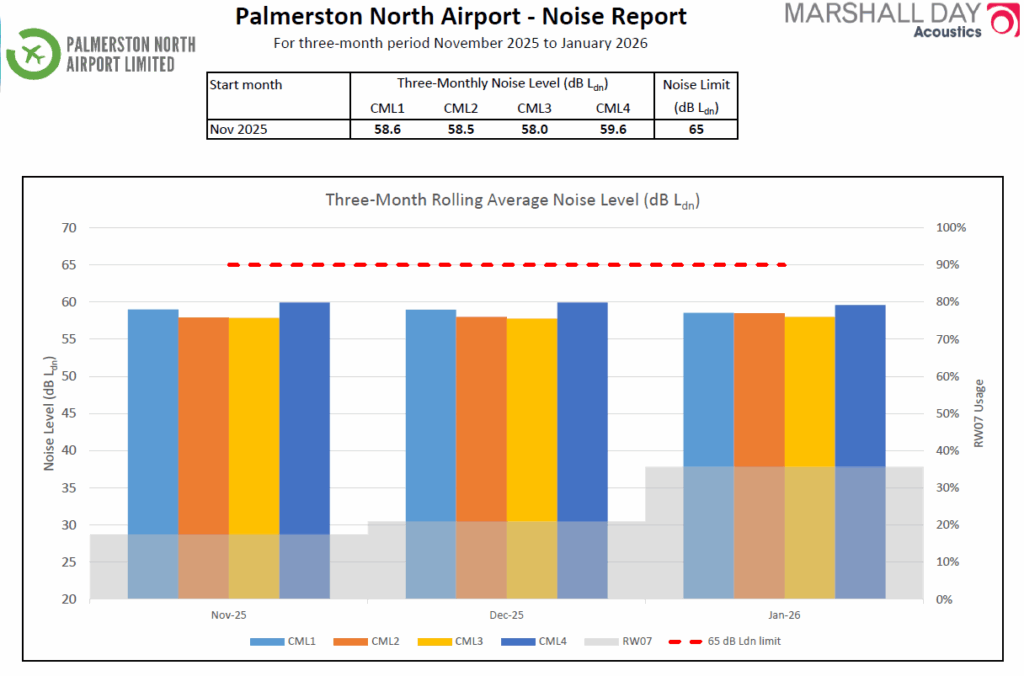
Aircraft operations noise is monitored at four Compliance Monitoring Positions (CMLs) located on the Airnoise Boundary (ANB) around the Palmerston North airport runway. The ANB is the outer limit permitted for average aircraft noise levels up to 65 decibels (db).
A “count and calculate” method is used to derive aircraft noise each month. Aircraft movement data associated with each sealed runway (07 & 25) are matched with established noise profiles for individual aircraft types by runway and CML position, this data is then aggregated creating an overall three-month rolling noise profile by CML, allowing us to evaluate whether the total aircraft noise generated is within the levels set in Section 13.4.6 of the Palmerston North City Council District Plan.
A graph summarising noise by CML is published on the Palmerston North Airport website below and is updated every three months.
Applies to all on-aircraft engine testing that is performed at Palmerston North Airport.
In-field measurements of noise was undertaken at three unattended noise monitoring terminals (NMTs) placed at different positions including two located at the closest residential boundaries to the airfield activity (NMT2 & NMT3).
Engine-testing logs were provided by the Airport Company for a representative sample of activity during 2023 to establish what noise is directly attributable to engine testing at the NMTs, as opposed to aircraft operations or ground-based noise or other extraneous noise source).
Assessed Engine-Testing noise levels (LAeq) at the residential boundary were as follows*:
NMT2 Day 33-42db
NMT3 Day 44-47db
*Engine testing is restricted to daytime (0700 to 2200 hours only).
As there is no continuous monitoring of engine testing noise, three yearly engine testing noise assessments are undertaken, unless there is a significant increase in engine-testing activity, or in the event of regular night-time engine testing taking place.
This involves all aspects of aircraft handling at Palmerston North Airport, as well as aircraft ground operations except on active runways, for example taxing of aircraft from and to the active runway, engine startup and shutdown, the operation of aircraft auxiliary power units whilst parked, the loading of cargo, and aircraft refuelling.
In-field measurements of noise from ground-based operations were also undertaken during 2023 using the three unattended NMT’s discussed above.
Measurements covered source noise level, ambient noise level, background noise level and the maximum noise level. Movement data for all vehicles and ground-based activities was provided by the Airport Company for a nine-day period to establish what noise is directly attributable to ground-based operations as opposed to engine testing or aircraft operations.
Measured Ground-Based operational noise levels at the residential boundary were as follows:
NMT2 Day38-41db, Night 36-53db
NMT3 Day 40-44db, Night 37-49db
As there is no continuous monitoring of ground-based operations noise, three yearly ground-based operations noise assessments are undertaken, unless there is a significant increase in aircraft operations or freight activity, or significant change in airport infrastructure that may give rise to a significant increase in ground-based operations.
airport noise queries and complaints process
Please complete the form available here. Alternatively, phone us on 06 351 4415, email info@pnairport.co.nz Subject: Noise Query, or post to Noise Query: Palmerston North Airport Ltd, PO Box 4384, Palmerston North.
Please provide these details:
- Name
- Contact details
- Date/time and location of noise event
- Nature of complaint (i.e. jets flying overhead, helicopter circuits, engine testing)
Noise queries are logged and investigated as they arrive with a preliminary response provided within five working days and a final written response within 20 working days.
Any relevant information as to the cause of the incident such as weather conditions and flight path are recorded. Arrangements are in place with local aircraft operators, Air Traffic Service providers and RNZAF for investigating complaints.
noise management compliance
24/7 General Enquiries
06 351 4415
info@pnairport.co.nz
Palmerston North Airport
Airport Drive, Palmerston North 4442 NEW ZEALAND
PO Box 4384,
Palmerston North 4442